Grid project Niederwil – Obfelden
Swissgrid is planning a new 380-kilovolt line between Niederwil and Obfelden. The new line is essential for power transit and security of supply in the cantons of Aargau and Zurich.


The Swiss Federal Office of Energy (SFOE) has proposed a corridor, including transmission technology (overhead line or underground cable) for the specific planning of the new line. It is based on the recommendation made by a monitoring group. The proposed planning corridor runs as an overhead line from the Niederwil substation south-east of the settlement area of Besenbüren and then passes under the Reuss as an underground cable south of Jonen. From there, it is once again planned as an overhead line to the Obfelden substation.
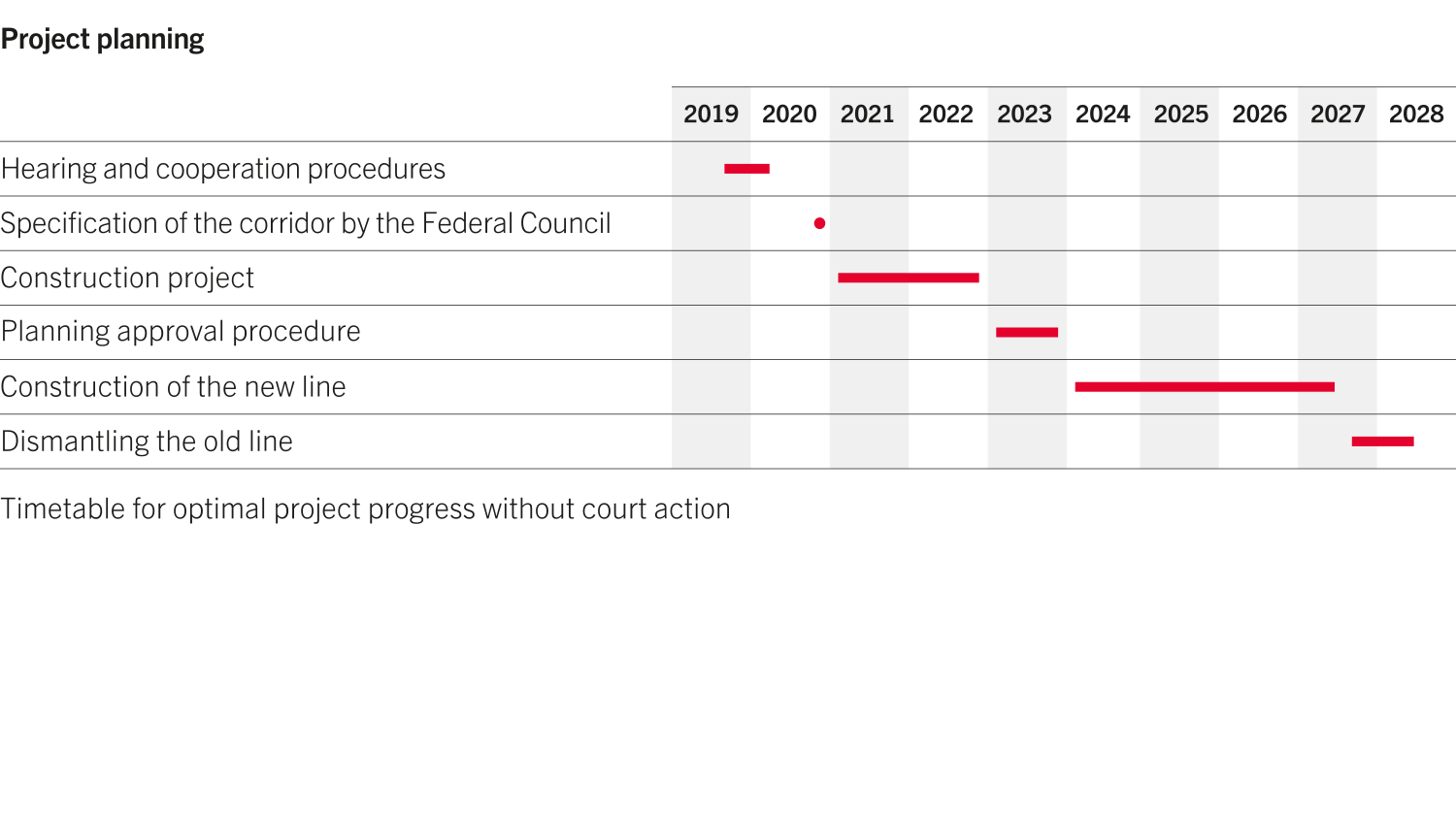
The SFOE will place the proposed planning corridor in a public cooperation procedure from 2 December 2019 to 29 February 2020, during which communities, associations and private individuals can make statements.
This project provides for the upgrade or replacement of the 17-kilometre 220 kV line between the substations at Niederwil (AG) and Obfelden (ZH) with a 380 kV line. The line is part of the upgrade programme from Beznau to Mettlen. The Beznau – Mettlen line currently causes congestion in the Swiss and European transmission grid. The upgrade of the line will improve energy distribution in Central Switzerland and the supply for greater Zurich. The north-south connections have to be upgraded, which includes upgrades beyond the borders. The new production patterns, such as the expansion of wind power in Northern Europe and shutdown of nuclear power plants, require increased exchange of electricity of Switzerland with Europe.
For each grid project, Swissgrid checks both cable and overhead line options. The Federal Council reaches a decision for an underground cable or an overhead line during the sectoral plan process. A monitoring group deployed by the Swiss Federal Office of Energy provides the Federal Council with recommendations in defining the planning corridor and in deciding on the technology (overhead line or underground cable). For this purpose, it discusses and evaluates the versions prepared by Swissgrid. The evaluation scheme for the transmission lines is the decisive factor here. Spatial development, the environment and economic efficiency are factors which are taken into consideration in addition to technical aspects.
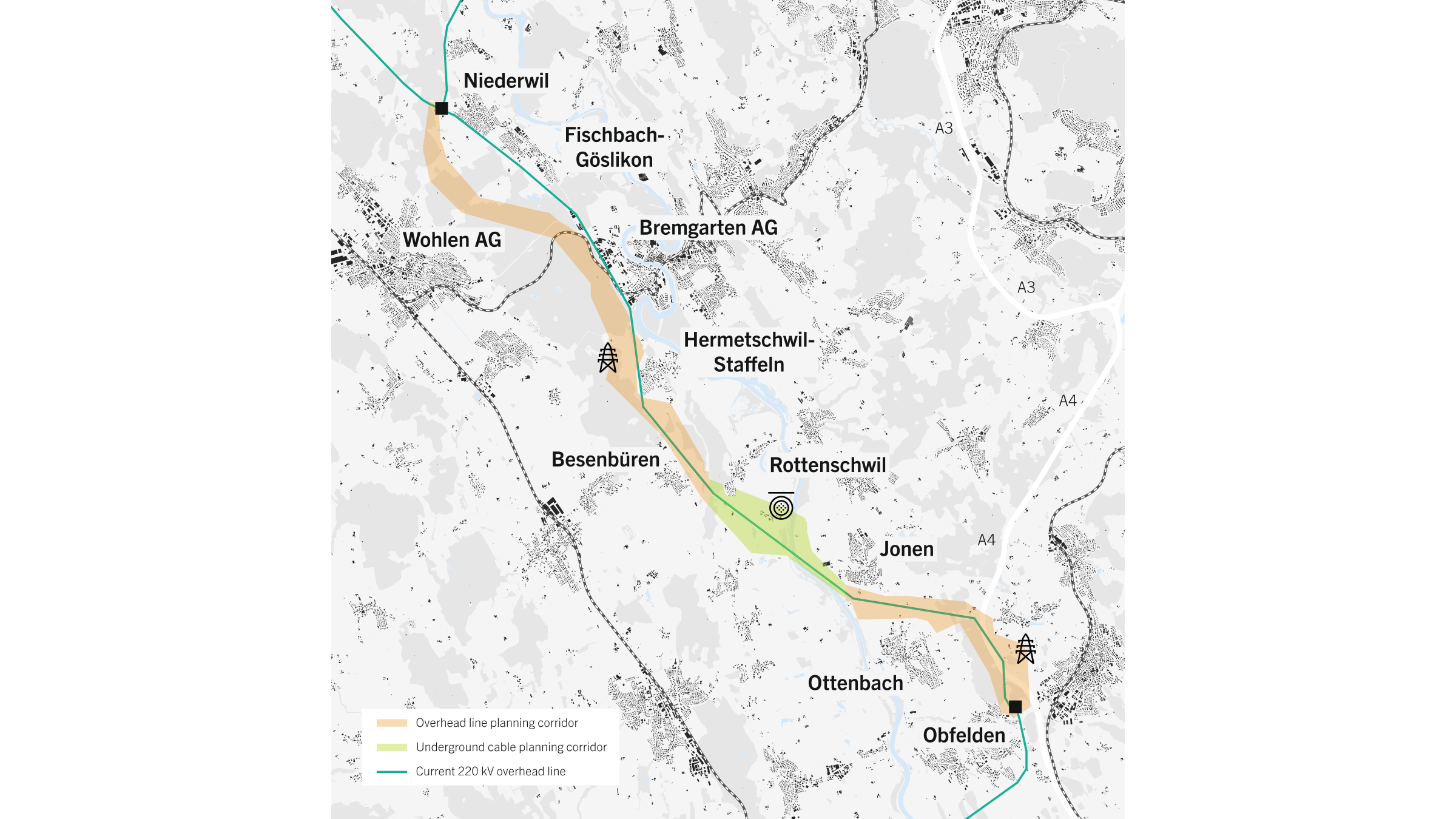
In August 2016, the Federal Council specified the planning corridor for the new Niederwil – Obfelden extra high voltage line. After this, Swissgrid prepared various planning corridors for cabled, partially cabled and overhead line versions within this area. These were then reviewed by the monitoring group deployed by the SFOE, comprising representatives from the federal government, cantonal authorities, environmental associations and Swissgrid.
Overhead lines are visible objects in the landscape and can have a negative impact on the landscape depending on their location. The interventions must be assessed by the federal government and the cantons in accordance with the protection objectives and the consideration of compliance with the federal tasks (ensuring the supply of energy).
Underground cables are generally assessed more favourably in relation to the landscape than overhead lines. While the cable route is not visible on open terrain, it remains clearly visible in forested areas as a necessary zone without deep-rooted and high trees must be maintained.
Interventions in groves by route clearing and/or the suppression of growth. Higher pylons make it possible to cross above the forest. However, the effects on the landscape are greater. The land under overhead lines can be used for agricultural purposes.
Interventions in groves are greater than the interventions required for an overhead line due to the need for route clearance. The cable route is clearly visible in the forest because, for underground cables, the area above the line has to be kept free of high trees and deep-rooted plants. The soil above the underground cable can be used for agricultural purposes.
Soil sealing takes place on a small scale around the pylon foundations. Temporary interventions, especially around the pylon locations, during the construction phase.
Extensive impact during the construction phase. Around 20,000 m2 of soil is impacted to construct an underground line 1 kilometre long (construction, installation locations, construction tracks). Depending on the electricity load, the electrical losses heat the underground cable and the surrounding soil. Measuring installations are used to measure and monitor the soil temperature. Soil sealing takes place on a small scale around the coupling shafts.
The noise emissions are caused by electrical discharge on the conductors (corona noises), which occur on high-voltage overhead lines under certain weather conditions, such as fog, rain or snow.
In the operating phase, the noise emissions originate from compensation systems. Compensation systems emit a humming noise similar to transformers.
The magnetic field depends on the current and the phase arrangement of the conductor. In an overhead line, the limit of 1 microtesla is complied with from a distance of about 60 – 80 metres from the line axis.
In underground cables, the magnetic field depends on the current, the installation depth and the cable arrangement. The spatial expansion of the magnetic field is lower than for overhead lines, but the strength directly over the underground cable is much higher than under an overhead line. The limit of 1 microtesla is complied with from a distance of about 6 – 8 metres from the line axis of the underground cable. The magnetic field can amount to more than 100 µT directly above the line. A value of 100 μT must not be exceeded from a soil distance of 20 cm.
Electric power transmission leads to electrical losses. A small portion of the power is transformed into heat. The voltage causes losses as well. With overhead power lines, these are known as «corona losses,» because the air serves as an insulator. In cables, it is the insulating material that conducts a small portion of the power, likewise resulting in losses. Since cables have a significantly larger cross section than overhead lines, they experience much lower conductor losses than the latter. However, the interplay of cable and grid generates reactive power, which has to be compensated for. These losses are much higher with cables than with overhead lines.