
Grid project Niederwil – Obfelden
Swissgrid is planning a new 380-kilovolt line between Niederwil and Obfelden. The new line is essential for power transit and security of supply in the cantons of Aargau and Zurich.


This project has been designed to expand and/or replace the 17 kilometre, 220 kilovolt line between the Niederwil (AG) and Obfelden (ZH) substations with a new 380 kilovolt line. The line is part of the Beznau to Mettlen expansion programme. It will permanently improve and secure the supply of energy to the consumer centres in the regions of Aargau West, Zurich North, the left bank of Lake Zurich and Zug.
The project is part of the Swiss government's sectoral plan process, which is used to coordinate projects that have a significant spatial and environmental impact. On 31 August 2016, the Federal Council finalised the planning territory for the new 380-kilovolt line from Niederwil (AG) to Obfelden (ZH). Swissgrid developed possible planning corridors for underground, partial underground and overhead line versions within the planning territory. These will be reviewed by the monitoring group set up by the Swiss Federal Office of Energy, consisting of representatives from the federal government, cantonal authorities, environmental associations and Swissgrid. The monitoring group provides a recommendation for the planning corridor as well as the technical underground, partial underground or overhead line versions using the «Evaluation Scheme for Transmission Lines».
Before the corridor versions were evaluated by the monitoring group, Swissgrid consulted with the affected municipalities, environmental associations, regional planning associations and the Reusstal Compatible Power Line Association (VSLR) in the planning process. The Swiss Federal Office of Energy, the cantons of Aargau and Zurich as well as Swissgrid will hold a public information event before the public consultation on the planning corridor proposed by the monitoring group.
In the canton of Aargau, the cantonal structure plan will be adapted in parallel with the sectoral plan process. The cantonal structure plan for Zurich does not require any changes as a result of the planning territory being defined.
Within the planning corridor defined by the Federal Council, Swissgrid then works out the concrete line routing for the detailed project and submits a request for planning approval. During the project's history spanning more than 30 years, two sections have already been realised (in connection with the road building projects «Bremgarten detour» and «A4 motorway»).
Schedule in the optimal case (without appeal to the courts):
| 15 July 2013 |
Start of the sectoral plan process |
| 3 September 2013 | Information event for municipalities and associations |
| 24 February 2015 | Information event for authorities, associations and the general public before the circulation of the planning territory |
| 31 August 2016 | Specification of the planning territory by the Federal Council |
| 16. Februar 2017 | Information event for local authorities and associations |
| 2018 | Public consultation / cooperation procedure on the planning corridor |
| 2018 | Information event for authorities, associations and the general public before the circulation of the planning corridor |
| 2019 | Specification of the planning corridor and the technology by the Federal Council |
| 2021 | Start of the planning approval procedure |
| 2022 | Planning approval decision |
| 2024 | Commissioning of the new line 380 kilovolt line |
| 2025 | Dismantling of the existing 220 kilovolt line |
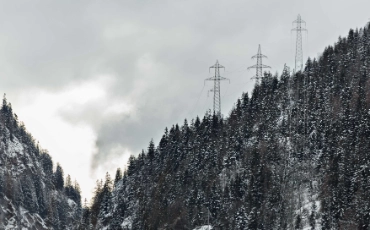
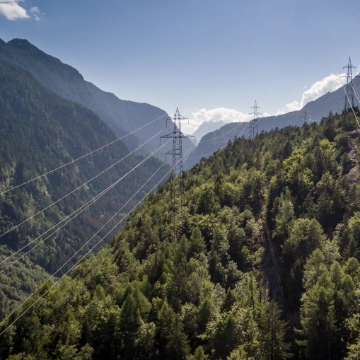
Overhead lines are visible objects in the landscape and can have a negative impact on the landscape depending on their location. The interventions must be assessed by the federal government and the cantons in accordance with the protection objectives and the consideration of compliance with the federal tasks (ensuring the supply of energy).
Underground cables are generally assessed more favourably in relation to the landscape than overhead lines. While the cable route is not visible on open terrain, it remains clearly visible in forested areas as a necessary zone without deep-rooted and high trees must be maintained.
Interventions in groves by route clearing and/or the suppression of growth. Higher pylons make it possible to cross above the forest. However, the effects on the landscape are greater. The land under overhead lines can be used for agricultural purposes.
Interventions in groves are greater than the interventions required for an overhead line due to the need for route clearance. The cable route is clearly visible in the forest because, for underground cables, the area above the line has to be kept free of high trees and deep-rooted plants. The soil above the underground cable can be used for agricultural purposes.
Soil sealing takes place on a small scale around the pylon foundations. Temporary interventions, especially around the pylon locations, during the construction phase.
Extensive impact during the construction phase. Around 20,000 m2 of soil is impacted to construct an underground line 1 kilometre long (construction, installation locations, construction tracks). Depending on the electricity load, the electrical losses heat the underground cable and the surrounding soil. Measuring installations are used to measure and monitor the soil temperature. Soil sealing takes place on a small scale around the coupling shafts.
The noise emissions are caused by electrical discharge on the conductors (corona noises), which occur on high-voltage overhead lines under certain weather conditions, such as fog, rain or snow.
In the operating phase, the noise emissions originate from compensation systems. Compensation systems emit a humming noise similar to transformers.
The magnetic field depends on the current and the phase arrangement of the conductor. In an overhead line, the limit of 1 microtesla is complied with from a distance of about 60 – 80 metres from the line axis.
In underground cables, the magnetic field depends on the current, the installation depth and the cable arrangement. The spatial expansion of the magnetic field is lower than for overhead lines, but the strength directly over the underground cable is much higher than under an overhead line. The limit of 1 microtesla is complied with from a distance of about 6 – 8 metres from the line axis of the underground cable. The magnetic field can amount to more than 100 µT directly above the line. A value of 100 μT must not be exceeded from a soil distance of 20 cm.
Electric power transmission leads to electrical losses. A small portion of the power is transformed into heat. The voltage causes losses as well. With overhead power lines, these are known as «corona losses,» because the air serves as an insulator. In cables, it is the insulating material that conducts a small portion of the power, likewise resulting in losses. Since cables have a significantly larger cross section than overhead lines, they experience much lower conductor losses than the latter. However, the interplay of cable and grid generates reactive power, which has to be compensated for. These losses are much higher with cables than with overhead lines.