
Grid project Beznau – Birr
Swissgrid is expanding the existing line between Beznau and Birr to 380 kV. One section of the line will run underground in future. The 220 kilovolt line that passes through Neu-Riniken will be dismantled.


The existing 220-kilovolt Beznau – Birr line is part of the expansion programme between Beznau (AG) and Mettlen (LU). The line is a bottleneck in the Swiss transmission grid. To increase capacity, this entire line will be converted to a voltage of 380 kilovolts. The line will be partially laid underground in the Bözberg/Riniken area («Gäbihübel» region). The project consists of the 1,3-kilometre cable route, two transitional structures (connection between the underground line and the overhead line) as well as the 5,2-kilometre overhead line connections between Rüfenach and Schinznach.
The project consists of the 1.3-kilometre cable route, two transitional structures (connection between the underground line and overhead line) as well as the 5.1-kilometre overhead line connections from pylon 20 in Rüfenach to pylon 30 in Krähtal to the northern transitional structure, as well as from the southern transitional structure to pylon 32 in Villnachern to pylon 37 (237) in Schinznach.
The northern transitional structure will be constructed in Pfaffenfirst in the municipality of Riniken. The transitional structure will be used to connect the underground cable to the overhead line and is about the size of an ice hockey rink. A small amount of permanent forest clearance and suppression of forest growth will be necessary for operation. The access route for construction traffic to the northern transitional structure passes through the municipality of Bözberg. The southern transitional structure in the municipality of Villnachern will be located to the south of the SBB railway embankment. The drilling method will be used to construct the SBB railway line underpass.
The costs for the entire project amount to CHF 28 million.

| Systems | One system at 380 kilovolts, the other at 220 kilovolts, operated for the service life of 40 years |
| Dimensions | 12 cables laid in parallel 2 parallel systems, each with 2 cables per phase |
| Cross-section | XLPE cable, 2500 mm2, aluminium |
| Protection | Each phase has 2 cables in a separate cable conduit |
| Weight | The cable weight amounts to approx. 21 kilograms per metre |
The calculations and forecasts of the grid load have shown that, in the «Strategic Grid 2025», the electrotechnical design of individual grid systems can be redimensioned compared to the previous assumptions. This affects the Beznau – Birr – Mettlen line, amongst others. Analyses on the security of supply have shown that the reserve cable is not required for the «Gäbihübel» partial underground cabling. The insulation of both cable systems is also not yet necessary for 380 kilovolts. One system will be procured for a voltage of 220 kilovolts only and will be operated at this voltage. These cables would have to be replaced to increase the voltage to 380 kilovolts. Swissgrid estimates that the increase in voltage will only take place after the end of the cables' service life. This adjustment allows considerable cost savings to be achieved with regard to the modernisation and demand-driven expansion of the Swiss transmission grid.
During the construction phase, the trench for laying the underground cable is about 25 metres wide. This reduces to around 5 metres during the operating phase. The route with partial underground cabling will be laid in open terrain with a conduit block at a depth of about 2 metres.
The construction time is about three years. The existing 220 kilovolt line will be dismantled following commissioning of the new 380 kilovolt line.
| 30 September 2013 | Planning submission |
| October 2016 | Legal planning approval |
| 2017 – 2018 | Procurement of the cable and line systems |
| 23 August 2018 | Ground-breaking ceremony |
| End of 2020 | Commissioning of the new 380 kilovolt line |
| 2021 | Dismantling of the existing 220 kilovolt line |
Every project allows design latitude. When the members of the project advisory council express their opinions candidly, point out options for action and thus make constructive contributions to the discussion, the foundation is laid for applying this design latitude to best effect. In this sense, the project advisory council is a consultative forum in which mutual understanding is promoted and different concerns can be raised directly. This is intended to optimise project communication and increases acceptance.
The project advisory council was deployed up to the completion of the planning approval procedure in 2016. The following persons were members of the project advisory council:
| Municipality of Bözberg | Heinz Dätwyler, Municipal Councillor |
| City of Brugg | Daniel Moser, Chairman of the Municipality |
| Municipality of Riniken | Daniel Obrist, Vice-Chairman of the Municipality |
| Municipality of Villnachern | Christoph Kamber, Municipal Councillor |
| Birdlife Aargau | Max Gasser |
| Pro Natura Aargau | Dr. Johannes Jenny |
| WWF Aargau | Tonja Zürcher |
| AKUT | Andreas Brack |
| Landowner, Bözberg | Markus Kreis |
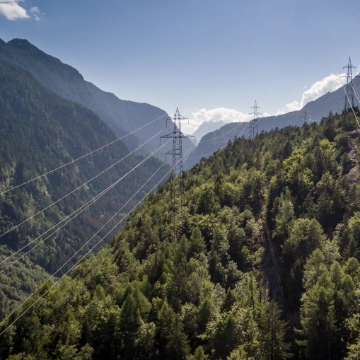
Swissgrid will implement the most landscape-friendly line route possible when constructing the Gäbihübel partial underground cabling. Different versions and combinations of the cable route, locations of the transitional structures and the overhead line connections were reviewed. For example, the original position of the northern transitional structure was optimised so that it is concealed by the forest wherever possible. The overhead line connections are sympathetic to the landscape by blending in with the forest skyline.
An underground line causes electric and magnetic fields just like an overhead line. While electric fields are intercepted by the shielding in the cable, magnetic fields are generated externally. The spatial expansion of the magnetic field is lower than for overhead lines, but the strength directly over the underground cable is much higher than under an overhead line. The limit of 1 microtesla is complied with from a distance of 6 – 8 metres to the line axis of the underground cable, while the corresponding distance for the overhead line is about 60 – 80 metres.
The «Gäbihübel» partial underground cabling project will allow important knowledge to be gained on the underground cabling of extra-high-voltage lines. Swissgrid is therefore developing a scientific programme in consultation with the competent authorities and departments. The aim is to check the assumptions that were made for the dimensioning of the underground line and involves recording the underground line's impact on the soil. A comparison of the measurements with the calculations allows conclusions to be drawn about the reliability of the assumptions made.
In particular, the following points will be analysed during operation:
Permanent forest clearance (about 4,000 m²) will be carried out for the northern transitional structure, opposite the garage on Bözbergstrasse as well as for the pylon locations. Temporary forest clearance will occur at the location for the northern transitional structure and for the pylon construction sites in the forest (about 17,000 m²). The forestry work will be carried out from the winter of 2017/2018. The reforestation activities for the permanent forest clearance areas will take place in Linn, in the municipality of Bözberg, and in the areas in which pylons are removed.
